Showing posts with label SGuide. Show all posts

Thursday, 19 October 2017

Fractions to decimals: try this out!

This morning we had the privilege of observing Jo Know in action with some of our target group learners. These students are working at standard 6 in maths. This places just below the national standard in maths. Normally a very talkative group they were very quiet. A number of differences for these students
1. New teacher
2. Not in the normal class setting
3. 5 teachers watching their every step
You can see that it was a hard task for our students to relax at first and get into things. Once they did we learned so much! We could see a clear need to develop language and understanding around the focus of session. This was on converting fractions to decimals and vice versa.

Things we can try:
1. Give students the chance to try the following on their own bit of paper, reassure them it's not a matter or right and wrong. It's a matter of trying out any strategy they have.

2. Have students fold paper strip into halves, lable, the same again for quarters then eighths. This seemed straight forward to our students. However once asking to go back to identify now what 3/4 were AFTER paper was folded into eighths, this really threw them. The became indecisive. The prompt for decision making was made when made to use a scissors to quickly cut quarters with a countdown from 5. This action seemed to plant more understanding, some very nervous to decided where to cut!

Here's how it all started:
Teacher could ask the following (to check where students are at)Can you write 0.27One tenth?Three fifths?Five quarters?One tenth as a decimal?0.27 + 0.2 =?

We discovered a number of work ons and were led by Jo to the following the next steps when in class in next with target group:
** Next step going back to improper fractions
Use double number and more line for this.  3/2….the 3 is the ‘COUNT’ of how many halfs.
Lines would be:
  • Whole number line
  • ½ line
  • ¼ line
Materials, push the imaging

Where they can’t work things out...go back to materials then back to imaging

Below is an example of a number line to develop understanding of equivalent fractions and to work with in use of improper fractions.

Monday, 25 September 2017

Preparing for Term 4 - time to reflect


A neat aspect of our blog posts is the use of our labels. This I have used to reflect with in preparation for term 4. Create continues to be a focus we talk about with colleagues, we create and share whether successful or not so.

On clicking on my labels from the 'Create' area we can look at what I've tried out and discovered. It's also very helpful to ensure I start off where I left off!

CReflect - click to see related posts

Focus of most of my reflections have been on my use of language in maths.  In this section key phrases are important for me to be mindful of in my planning.    Being 'explain ready' as a teacher AND student.    This means being prepared with the activities AND language that will promote learning.  When 'Creating' - I am promoting the correct use of mathematical terms and processes to best support my learners.

CTry - click to see related posts

What I have tried is the use of students data to empower learning.  This has proven to be successful in
1. Gaining greater buy in from learners
2. Learners are empowered and feel more in control of their results and data
3. Learners are more reflective when seeing their own data
4. Students are making comparisons and conclusions for themselves around learning and goal setting

CPlan - click to see related posts

The COL staff meeting we led prompted the following thoughts for me.  Am I sharing clear enough steps in my practice here on my blog?  Are they good enough for another teacher to pick up and work from.  If the answer is yes - then my plans are useful as a COL.  Planning for me to date needs to include what key words and phrases I will promote.  What vocab will be best support learners when having to various assessments and working with maths in day to day life.

Labels to be covered more in Create are: innovate and implement.


Thursday, 17 August 2017

Teacher talk is so important! Being 'explain ready'.

This afternoon was time well spent with Jo Knox and colleagues from year 5 through to 8.   The focus for our group PD was on the teaching and learning of fractions - ratios and proportion.   As the workshop unfolded it highlighted the following

- How we set problems to solve
- How we phrase our prompts and questions
- Which parts of a word problem to we spend time on teaching
- Which parts are redundant - not useful

This links to what I have found in parts of my inquiry.  The teacher's ability to articulate mathematical operations through to problem solving is significant in the learner's ability to advance in maths.   Where a teacher creates tasks effectively, use of correct terminology and mindfulness of scenarios learners may come up with - the thinking process of students is set up with greater stability.  The thinking process taken will prompt a transfer of skills across strands.  

Again I find myself reflecting on my own methods of setting up maths learning.  The language and phrases I use in maths to prompt the solving of various maths problems.   Jo Knox referred to the basics of how we describe fractions - what works and doesn't.   The part that doesn't work - showed thinking processes that were very limited and did not support the transfer of knowledge into other strands.   PD for myself - get explain ready for whatever scenarios students come up with in their efforts to problem solve.

The following are some helpful tips from Jo Knox's session.
  • Some students in ratios use additive - stage 6
  • We want to move into multiplicative
  • ‘Launch’ of question. Ensure all students have access to understand the question. It’s not meant to trip up students. Explain different parts to allow students access to the question.
  • Whatever your problem area. Do a 5 minutes piece with class daily. Maths wall could show the processes you want to teach.  
    • Who can find keywords? etc
    • Where are the key numbers?
    • Redundant? Who can find words that are NOT useful
  • Do exercise to picture what you’re trying to ask WITHOUT numbers. E.g. ‘I have money in this pocket and some in this one...how much do I have’. 
    • Students will understand what operations you’re after BEFORE dealing with the numbers.

Thursday, 20 July 2017

Explain ready as students - next steps.

Graeme Aitken: Collaborative Teaching as Inquiry Image from collaborative inquiry presentation given to school leaders at Manaiakalani Hui Term 2.

As the term kicks off I've used this inquiry flow chart to focus myself on what the next part of my inquiry will be. You open the lid with investigation from your hunch, you may find you were right OR close, or maybe - that the issue is something else!

The start of my inquiry?
Using student data WITH students to support achievement in maths. What has unfolded is a careful selection of words and phrases from me as a teacher to model how we interpret our data from formative assessments so far. These being gloss, IKAN test and small group work.

On expecting students to articulate back to me via blog posts and conversations I have picked up that the students were able to identify the strand area of weakness. This was hugely motivational and built confidence in a number of nervous students. However the next problem became obvious. It's the next level of detail we are actually after! So if you say - 'Proportions and Ratios' is the area of weakness in number - what IN proportions and ratios is the problem area. What are the building blocks that lead me into understanding fractions (proportions) and then ratios? Students goal: to be 'Explain Ready'. Using collaborative teaching inquiry model from Graeme Aitken I have come up with the following to guide me through the next steps for my inquiry.
Inquiry that Hannah West shared in our Pt England School inquiry groups.   Thanks Hannah for your great ideas around screencast!    Will show what we come up with soon!


Friday, 30 June 2017

Screen casts that 'Explains and shows' my understanding

Following on from our staff meeting led by Dorothy Burt we had our own Pt England group inquiry session.  In this session we are invited to share and reflect on progress today with our own individual inquiries.

I will share about the findings of a colleague around the use of capturing screen casts that display a student working through a problem.  In this you will see their working out with a voiceover that is captured at the same time.

The idea I plan to implement with my target group is this very activity of having students capture their explanation of maths problems they tackle.  

Plan of action:
1. Demo working out a problem they find easy using screen capture
2. Demo working out a problem that is challenging for their maths group

I will need to support this process well with helping students to  identify specifically a problem to solve.   Also the skills needed to capture their explanation/working out well so that their example is a clear example of 'Rewindable Learning' for their peer group.

Screencastify - tutorial video

Friday, 16 June 2017

Whanau engagement a big part of solution

Whanau engagement is a fundamental part of student achievement and well being at school.   Our efforts to understand one another is significant in not only engaging students but maintaining the levels of motivation and interest from the students AND their whanau over years of schooling.

Families@PES is what we now call our 'Home school partnership' meetings.  In this post I will refer to the Families@PES night June 14th 2017.  The special focus of this meeting was achievement in maths for all our students.

Toni Nua one of our assistant principals led this evening.  Starting with the good news - any support we can offer as whanau around maths matters!  This was great as there have been some miscommunications over the years of the 'old way' not being good for our students.   Instead - it's another strategy to offer our children.   Greater to this was the fact that we all - teachers, parents and whanau need to 'talk' a lot more!  For example - when we're doing chores around home, travelling to and from shopping trips - there's so much maths talk we could be having.

I had the chance to work with parents of year 7 & 8 parents who attended this night.  I shared my findings after having completed a set of gloss tests with students.   Language is greatly lacking.  Gloss is a test that uses 'Word problems' for students to show their ability in the three following areas:
Addition and Subtraction
Multiplication and Division
Proportions and Ratios

I showed parents an example of a gloss question.  They were very interested and were keen to learn what their children face in an assessment.   I was able to explain with the test in hand the challenge our children have with interpreting word problems.
'Andrea can fit 5 basketballs into one sports bag.  How many bags will Andrea need to store 40 basketballs?'
Some students will become stuck - yet when showing them the number sentence 40÷5= they could say the answer immediately.  So how can we all help?   Heaps and heaps more 'talk'.  Gifting of language to our children is needed.  Research relating to the time some of children enter school show very low word knowledge compared to children the same age in other parts of NZ.  Let's get talking - explaining with our children!

This will be an aspect of the maths I will address with my maths class in the new term.

The evening closed with parents feeling more empowered to support their children and helpful reminders that in the busyness of home life we can plant many more words/phrases and conversations that will better support their children towards achievement in maths.   All parents left with a maths activity pack that was explained and used prior to leaving this evening.

We've since received feedback that it was a useful evening and the packs are a great help!   Another great resource in our whanau to support achievement for our tamariki.


Tuesday, 30 May 2017

Creativity Embeds Learning


 Dorothy Burt led us through our staff meeting Monday May 29th. I was privileged to be part of this presentation along with other colleagues who have been using 'Creativity to embed Learning' over some years now. Sight, sound and motion were intentionally used to help students to have depth to their learning. Learning that would stick and stay! Please look through the below presentation as it covers a range of practices and beliefs we've carried out here at PES. They work! Thank you Dorothy for another inspiring session. Many good reminders of things we need to maintain and those we need to improve.

On  a personal and professional note there are some basics that classroom teachers need to put in place.   Basic structures to maintain so students have equitable access to tools that enhance and support their creativity.
1. A roster that works in rotations within class hours that has every child have access to the devices where animation, paint programs and iMovie can be accessed
2. A clear task and rubric to guide the students creation
3. A checkpoint weekly to show progress, give praise and prompts
4. An absolute doing away with the 'Creative' devices - (Apple flatscreens in our place) being used as a reward.  They are NOT - they are part of the everyday learning activities.
5. SHARE:  a showcasing of creative work on media such as PENN (School TV news network), class and individual blog, team/class viewing.
6. Feedback: Give students the chance to give feedback and reflect

Part of my teaching practice finds me role playing, singing, moving and rhyming to help my learners. This has meant my students have had the chance to reflect this in movies we've made to share our learning.    It's in these creative moments that I have witnessed first hand the embedding of their learning.  Embedding that runs deeper and wider where creativity is encouraged and expected.   Engagement high.

Monday, 16 January 2017

Teaching as Inquiry 2017 - COL

“Recognising and spreading sophisticated pedagogical practice across our community so that students learn in better and more powerful ways...”

The Manaiakalani Community of Learning is working together on this task using the expertise existing in of our community of learning.

In 2017 for my inquiry I have selected the following CoL achievement challenge 


#4. Increase the achievement of Years 1-10 learners, with a focus on Years 7-10,  in reading, writing and maths, as measured against National Standards and agreed targets.  My specific focus will be on maths.  However I will share from time to time on the other curriculum areas as I am able.

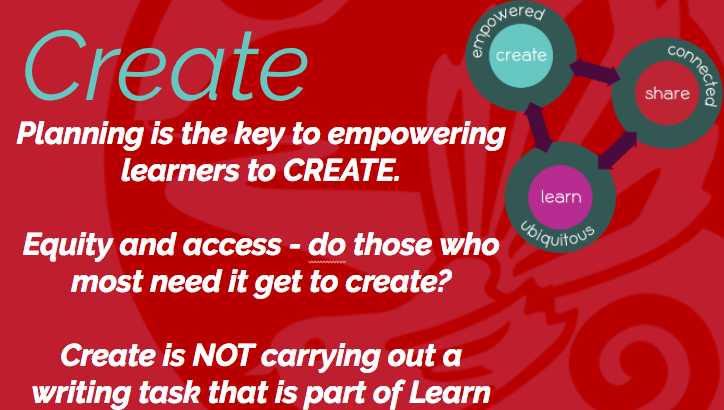
The teaching as inquiry framework I will be using in 2017 has been specifically co-constructed for Manaiakalani schools using our familiar Learn Create Share structure.
The elements in this framework share close similarities with other models New Zealand teachers use.


I will be labelling my posts as I update my inquiry throughout the year to make the content easy to access.

Labels:
LEvidence, LScan, LTrend, LHypothesise, LResearch, LReflect,
 CPlan, CTry, CInnovate, CImplement, CReflect,
SPublish, SCoteach, SModel, SGuide, SFback, SReflect

Label Key:


LEvidence
Learn - Gather Evidence
CPlan
Create - Make a plan
SPublish
Share - Publish
LScan
Learn - Scan
CTry
Create - Try new things
SCoteach
Share - Co-teach
LTrend
Learn - Identify Trends
CInnovate
Create - Innovate
SModel
Share - Model
LHypothesise
Learn - Hypothesise
CImplement
Create - Implement
SGuide
Share - Guide
LResearch
Learn - Research
CReflect
Create - Reflect
SFback
Share - Feedback
LReflect
Learn - Reflect


SReflect
Share - Reflect