Sunday, 16 August 2026

Kakala Framework and Manaiakalani Pedagogy Align

 
Mālō e lelei! 

It's Tongan Language Week (Uike ’o e Lea Faka-Tonga), I want to share a recent presentation delivered to our Manaiakalani staff. 

A focus of my sharing was exploring how Indigenous Pacific conceptual frameworks directly inform and support Tapasā—Aotearoa’s cultural competency framework for teachers of Pacific learners. Specifically, we examined Professor Konai Helu Thaman’s updated 2006 Kakala Framework, which uses the traditional Tongan art of garland-making as a philosophy for culturally responsive pedagogy and research.

As a key supporting document to Tapasā, Kakala provides the cultural foundation for how teachers can build relational ethics (Teu le vā) and high-expectation teaching practice. The six phases of the 2006 Kakala framework align seamlessly with our core Manaiakalani kaupapa of Learn, Create, and Share:

  • TEU & TOLI (Preparation & Selection) LEARN:  Teu (preparing the ground) and Toli (selecting and gathering the finest flowers and scents). This underpins Tapasā Turu 1 & 2 and mirrors how our tamariki Learn—preparing their minds, researching, and harvesting knowledge rooted in their heritage and curriculum.

  • TUI (Making & Weaving)  CREATE:  Tui (carefully weaving the garland together with purpose and skill). This aligns with Tapasā Turu 3 (Pedagogical Practice) and reflects how our learners Create—synthesising their ideas into meaningful, high-quality digital outputs and creative work.

  • LUVA, MĀLIE & MĀFANA (Gifting, Appreciation & Transformation) $\rightarrow$ SHARE:  Luva (gifting the finished kakala with humility) leading to Mālie (relevance/joy) and Māfana (warm empowerment). This embodies how our students Share—presenting their work to authentic audiences (whānau, peers, and community) to inspire and bring about real-world impact.

As we celebrate Tongan Language Week, this presentation serves as a powerful reminder that grounding our teaching in frameworks like Tapasā and Kakala ensures our Pacific learners thrive in their identity, language, and culture.

Thursday, 16 July 2026

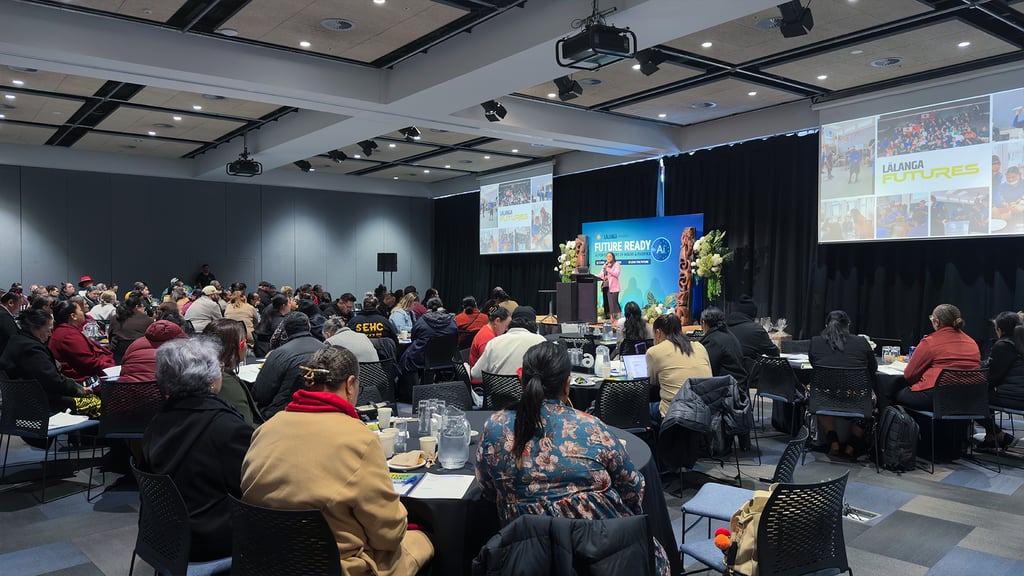
Future Ready: AI for Pasifika and Māori Educators 🌟

Recently alongside the leadership team from Homai, I attended the Future Ready conference hosted by Lalanga in South Auckland. This learning opportunity came to me via our Tatupu Cluster convenor, Sonia Johnston.   While we cannot always attend every single event ourselves, sharing these opportunities across our networks is so important for keeping us all connected and growing.  Fa'afetai tele le fa'asoa Sonia!

The conference itself focused closely on the role of Artificial Intelligence (AI) in the future of Pasifika and Māori education. A core part of our Manaiakalani network is our commitment to Learn, Create, and Share. Staying open to new learning, stepping outside our daily routines, and connecting with others helps us keep our mahi fresh.

It was affirming to see how much of our daily classroom practice already aligns with these national conversations, especially around equity and student empowerment. At the same time, seeing other ways of doing things gave us fresh perspectives and sparked new ideas on how we can continue to use AI in culturally responsive, safe, and exciting ways.

Thank you to our Tatupu Cluster convenor for passing on this invitation, to Lalanga for hosting, and to the Homai leadership team for their great companionship. We return to our schools ready to explore these digital tools together! 

The image below is from a piece completed by Tagata Pasifika.  Click on image to find the full article. 

Tuesday, 14 July 2026

Pasifika@Manaiakalani Conference 2026

 What an incredible day we had on July 7th at the Te Oro Music and Arts Centre in Glen Innes as we gathered for this year’s Pasifika@Manaiakalani Conference! It was deeply inspiring to welcome 80 passionate teachers and educators, all dedicating their valuable holiday time to reflect, connect, and champion our learners.

The day kicked off with an empowering keynote address from David Riley, "The Reading Warrior." David highlighted the vital role teachers play in making a way for our learners to fully engage in their learning. He challenged us to truly know and understand what our students love to do, using those authentic interests as powerful hooks to ignite learning—a message that resonates right at the heart of the Manaiakalani kaupapa.  Malo fa'afetai tele Tavita mo lou tāpena ma fa'asoa i lenei aso! 

Following the keynote, attendees immersed themselves in a rich selection of insightful workshops, diving into practical strategies, shared expertise, and meaningful discussions to take back to their schools and classrooms.

Another highlight of the day was our delicious brunch, lovingly prepared and served by Tāmaki College ex-students who are now leading the Tāmaki College hospitality course and building hands-on experience out of the Rise UP Trust. Seeing our former students step into leadership and serve our teaching community was a powerful, beautiful example of community and learning in action!

We extend our heartfelt thanks to the Manaiakalani Education Trust, TRC (Tāmaki Regeneration Company), and Community Kids Early Learning Centres for their invaluable financial support. 

A special thank you also goes to PBTech, Mena International Ltd, and Laupapa Trust for their generous donations of spot prizes, which brought so much extra joy and excitement to our attendees.

A huge fa'afetai to all of our dedicated workshop presenters for sharing their wisdom, and a massive fa'afetai tele lava to every teacher who attended. Your presence, energy, and unwavering commitment to our Pasifika learners made the day an absolute success.

Fa'afetai tele lava to everyone who contributed to making this year's Pasifika@Manaiakalani Conference so memorable and impactful. We look forward to continuing this journey together and hosting you again next year!

🌺Fa'afetai to 'The Five Stars' who own the track 'Pua Samoa' I have used in this reel.   

Tuesday, 5 August 2025

A STEAM Journey: Te Puke ō Taramainuku Kāhui Ako

Student from Flatbush Primary School, project on the Apia Clock Tower.

Oka oka se manaia o lenei avanoa!  I recently had the opportunity to visit a Te Puke ō Taramainuku Kāhui Ako event that was a powerful demonstration of how Science and Technology can be used to bring history and culture to life for students. It was immediately clear that the teachers were incredibly passive about forging these connections, ensuring a smooth transition from traditional knowledge to hands-on, creative learning. The day was centered around integrating STEAM principles into the curriculum, but with a unique and deeply meaningful twist: linking scientific and technological processes directly to cultural and historical inquiry through a variety of project-based stands.

Throughout the day, keynotes were delivered that encouraged learners to use their knowledge and experiences in STEAM to explore possibilities in the future. One particularly inspiring speaker was a 3D artist who worked on the iconic creature design for the film Predator. The speaker shared their personal journey, explaining how their career began as a hobby and led to them creating intricate 3D objects and creature effects for movie sets. The talk powerfully illustrated the potential for blending passion with history, scientific knowledge and technical skills.

The event was a vibrant showcase of student ingenuity. In one corner, a project focused on the cultural significance of the kawakawa plant. Students had used their knowledge of science and technology to make kawakawa balm, proudly sharing the finished product and even gifting a small pot to visitors at the end of each session.

Another project explored wind power using technology and science, creating a clear link back to the use of sails and the historical navigation of the sea on double-hulled canoes. The students explained how their experiments with wind energy connected directly to the ingenuity and skill of their ancestors as master navigators.

Nearby, another stand featured intricate 3D cardboard models of historical landmarks in Samoa. The students' understanding was brought to life in a remarkable way, as they had used Scratch and code to program their models to tell stories and play audio recordings. When I interacted with one of the models, it triggered a student's voice explaining the landmark's historical significance, the scientific principles behind its construction, and its cultural importance.

In another area, bilingual classrooms presented a series of captivating stop-motion projects. These short films were not only creative, but they demonstrated the students' command of storytelling, their technical skills in animation, and their use of both their native language and English.  A hands on experience was provided by the students for students from the cluster who visited during the day.

I visited a stand focused on the production of coconut cream. Students explained how the project was prompted by solving a real-life problem, and they had applied their knowledge of science and technology to explore the process of extracting the cream. They had even built a machine to "valu popo" (scrape coconut flesh) to improve the process and create a higher yield.

Each of these projects moved beyond simple recall, asking learners to synthesise knowledge. They showed that by using technology and science to explore their heritage, students can create powerful, personal, and engaging learning experiences that also serve their community. 

Malo lava le tāpena faiaoga ma lo outou vasega!   Ia maua e outou le fanau se lumana'i  e lelei ma aoga mo tatou tagata. 


Thursday, 31 July 2025

Celebrating Our First Pasifika@Manaiakalani Conference!

What an incredible day we had on July 1st at the Te Oro Music and Arts Centre in Glen Innes, as we gathered for our inaugural Pasifika@Manaiakalani Conference! It was truly inspiring to welcome a vibrant group of 80 eductors that included community workers, and even some cherished retired teachers. The calibre and passion in the room were truly inspiring.

The day kicked off with a powerful keynote address from Dr. Rae Siilata and Kyla Hansell, alongside their amazing team, Dr Martha Aseta, Grace Ormsby Abazu, and Avikaila Sopotulagi Tilialo. Their insights set a wonderful tone for the day, deeply resonating with everyone present. Dr. Rae Siilata opened with a powerful metaphor: "I walk backwards..." inviting us to reflect on the wisdom of our ancestors and the past to guide our steps forward. This resonated beautifully with the Samoan proverb, "E sui faiga, ae tumau fa'avae" (practices may change, but foundations remain), emphasizing that while our methods evolve, the core values and knowledge from our ancestors, highlighted from our Manaiakalani site, remain our unwavering foundation. Attendees particularly noted the profound knowledge and research shared, appreciating how deeply it aligned with Manaiakalani's kaupapa. Messages were well-supported by research around bilingualism, including the significant work of Jim Cummins. A key question stressed by Va'atele was: "Whose knowledge is being valued? What would our students and their families say we value as teachers and as a school?" This provocative inquiry encouraged deep reflection on our practices. The keynote provided a knowledge-rich experience, delivering important messages that extended beyond education to touch on humanity, leading to significant and valuable learning for all.

Following the keynote, attendees had the opportunity to dive into a rich selection of learning, with 12 diverse workshops offered across three rounds. There were four fantastic options in each round, ensuring something for everyone to explore and engage with.

A true highlight was our lunch experience at the Tātou Cafe, just across the road. We were so privileged to be hosted by the talented young people from Tāmaki College, who not only cooked but also served a delicious Pasifika-styled lunch to our entire group. It was a a beautiful example of learning and community in action, and a real treat for all!

We extend our heartfelt thanks to the Manaiakalani Education Trust and TRC  - Tāmaki Regeneration Company for their invaluable financial support. A special thank you also goes to PBTech and Mena International Ltd for their generous donations of items for spot prizes and draws, which added so much fun and joy for the teachers who attended! 

A huge fa'afetai to all our dedicated workshop presenters who delivered 12 insightful sessions, sharing their expertise and passion with our attendees. Finally, a massive fa'afetai tele lava to all who attended, especially for dedicating what should have been their holiday time to be with us and for adding so much by their very presence and contributions.

Fa'afetai tele lava to everyone who attended and contributed to making this first Pasifika@Manaiakalani Conference such a memorable and impactful event!  We look forward to hosting you again in 2026! 

Wednesday, 9 July 2025

Matamatika - the new Maths curriculum

Taimi o le Matamatika!

What a fantastic PD day we had for the new Maths curriculum, led so brilliantly by Donna and Elena from the Manaiakalani team – a huge thank you to them both! I really appreciated being walked through the different parts of the curriculum. While we know as experienced teachers that many pages of any new curriculum might not get a full read by busy classroom teachers due to workload and being time-poor, it was incredibly reassuring to get a clear overview of all the parts, the layout, and the expectations for our classrooms. Indeed, today's PD gave a clear message about our role in knowing the curriculum in detail to influence how we teach. No one can hold all the information in mind, but the act of checking in regularly with the finer print – for example, during termly planning overviews – is incredibly important.

One highlight for me was being coached about the 'Science of Learning'. It was a great visual – left side for the Ministry's approach, right side for our blue Manaiakalani MPI. It really clicked!


I also picked up on the promotion of using lots of oral language in our maths teaching, which is absolutely key. And I love that the growth of good relationships – between teacher and learners, and learner to learner – is acknowledged. This was a big focus of DMIC (Developing Mathematical Inquiry Communities), and it's wonderful to see this important aspect of teaching in maths being highlighted.

Speaking of that, we even had a go at a rich task with three colleagues – the very ones I'd been in a breakout group with that day. Our task was about shading shapes to make fractions. Initially, I started to feel a bit nervous. But, given how comfortable and safe I felt with the group, I decided to declare my barriers or "entry points," which was at the lowest end. This put me at ease and really helped me to relax, listen, and even understand others! I found myself able to apply the imaging of shapes, flipping them, and so on, to make up fractions. I went from feeling comfortable only with halves and quarters to looking at sixteenths – woo hoo! Elena highlighted that the smiles and relaxed feel we had on screen are the exact time and tone we want to keep in maths lessons, as it contributes hugely to maths being understood and enjoyed.

And here's a big one for us as teachers: if you think you're "not good at maths," we need to challenge and change that mindset. Our own beliefs about maths impact our students hugely! This new curriculum has a strong focus on enabling access for all our learners to all levels of maths. It's about acceleration, not remediation. In the past, we often identified where students were, then focused solely on "gap filling." The result, most times, was little to no shift, and learners remained in low achievement cycles. This curriculum aims to break that cycle. Don't hold learners back if they don't know basic facts – they will pick this up in other strands as they progress! This emphasis on accelerative practices within the curriculum truly resonates with Manaiakalani's core goals for learner progress and equity.

A key aspect of this curriculum is its strong push for using materials to build understanding. Think place value disks – materials are strongly advised to help learners grasp concepts concretely. Also, make sure to check out the videos provided on Tāhūrangi! These have been re-recorded to incorporate the new phases and curriculum, and they show some great examples of how to effectively use materials with learners in class. Playing games is also highly encouraged! Learners love this, and there are games suggested to link to specific phases and learning sequences.

When it comes to assessment, the message was clear: we need to continually monitor our students' progress, and this should directly influence our next steps with the resources available. We need to ask ourselves: are the right design scaffolds present? Are there opportunities for learners to apply their learning, revisit concepts, reteach, and consolidate understanding?

Our planning should integrate the interests and current events/activities of our learners, school, and community. Imagine getting our kids to consider the maths in a special cultural event – the cost to run it, statistics around participation and audience, and so on. That's real-world maths!


Currently, we're faced with choices about new resources. The key message from Elena and Donna was clear: be led by the curriculum first, and then the resources. Resources have different strengths – some offer rich tasks, others focus on practice. We need to shift our thinking to: "How does this resource support what the curriculum directs us to do?" Providers are supplementary, not the drivers of what should be taught. The curriculum guides the teacher, and the teacher guides how and when the resources are used. And a big one: if you have resources that have worked well in your classroom, KEEP THEM, USE THEM! Don't throw the baby out with the bathwater, as the saying goes! Remember, 70% of NZ Maths resources are available on Tāhūrangi – definitely check them out!

We also explored the strands, noting some new substrands like Financial Mathematics. It was great to delve into one of these. The curriculum provides a clear progression in the language required in maths, which you can see from Year 0 to Year 8 for each strand and substrand. Planning examples are available on Tāhūrangi, and it was emphasized that these are examples to be adapted and changed to suit your school and classroom – they are not exemplary, just a starting point.  Integrating maths across curriculum areas is another supported practice in this curriculum refresh.

There's much more I'm still processing from today, so take this as a taster! Want to know more? Join our MPI, or contact us at Manaiakalani to assist!

Friday, 29 November 2024

Saane Faaofo Oldehaver - Tautai+RTLB Fono

My reflections: 

The Role of NZPPA

The New Zealand Pasifika Principals’ Association (NZPPA) began in 2008 with only two members and has grown to over 100 Pasifika principals across the country. NZPPA is driven by Pasifika values, advocating for Pasifika voices in education. It provides professional development (PD) opportunities for principals, such as Tautai o le Moana, and promotes cultural responsiveness through initiatives like rolling out Tapasā and organizing bilingual education conferences.

As a former President of NZPPA, Saane led for two years. Despite feeling ill-equipped at the start, she embraced the role with determination and learned through the experience. She described it as a privilege to bat for Pasifika and to strengthen spaces where principals could safely share and support one another.

Strategies for Engaging Pasifika Learners

In her role as a deputy principal (DP), Saane highlighted strategies for teachers and Resource Teachers: Learning and Behaviour (RTLB) to engage Pasifika learners:

Tapasā is an essential working document that captures the voices of Pasifika learners and families. Teachers should use it to guide their practices.

Language and identity matter: Pronouncing names correctly and knowing learners’ cultural backgrounds are simple yet impactful starts.

High expectations: Setting a high bar helps Pasifika learners achieve their potential.

Service: Understanding how Pasifika children experience service within their home, church, or school contexts can enrich teaching approaches.

Patience and relationship building: Teachers must avoid assumptions and take time to understand the unique context of each learner and their family.

RTLBs should focus on meaningful interactions, such as greeting learners in their heritage language, to show they value the students’ cultural identities. Building trust with teachers and using talanoa to discuss classroom dynamics before addressing specific learners was another key suggestion.

A breakout session following Saane's talk showcased some excellent practices RTLBs use to introduce themselves and their services. RTLBs and schools are encouraged to negotiate times for these introductions every year or two to ensure alignment and awareness.

Talanoa Ako

Saane spoke about Talanoa Ako, a Ministry of Education initiative that supports Pasifika families to engage with schools. However, the current government is reviewing whether it will continue.

Pacific Leadership Advisor Role

As a Pacific Leadership Advisor, Saane worked alongside Pasifika principals and schools with significant Pasifika populations. This role emerged from the Tomorrow Schools Review and involved principals seconded for a year or two to work directly with others in the field.

Reflecting on this role, Saane shared how she fought for Pasifika perspectives in education and helped connect principals to resources such as Tautai o le Moana. She noted the lack of a dedicated team within the Ministry of Education to consolidate and share the many incredible external resources available for supporting Pasifika learners.

With the term ending, Saane will return to Weymouth Primary, bringing insights gained from this role, such as providing staff with opportunities to reflect on their practices and fostering cross-school collaboration.

Celebrations and Challenges

Saane celebrated the positive, supportive space NZPPA creates for Pasifika principals and the deep resource network she has helped uncover. She emphasized the importance of taking time out to explore what is available for professional growth and learner support.

However, she acknowledged that the work is relentless, with the demands of leadership making it difficult to find a work-life balance. While she continues to seek answers in this area, her resilience and adaptability remain central to her approach.

Advice for Aspiring Leaders

Saane encouraged educators considering leadership roles to take the leap. "You all have something to share," she said. While challenges may arise, much of the learning happens along the way.

Improving RTLB Services

At a recent conference focused on neurodiverse learners, Saane observed that RTLB services are on the right track and should continue their current efforts. For RTLBs working with Pasifika teachers, she stressed the importance of building relationships and having talanoa to understand classroom contexts before addressing specific learner needs.

Final Reflections

Despite initially feeling unprepared for certain leadership roles, Saane’s courage to step up has led to meaningful contributions to Pasifika education, the development and support of teachers and principals. Her journey exemplifies the power of reflection, connection, and a commitment to community-driven leadership. As she transitions back to her school, she brings a renewed focus on relationships, cultural fidelity, and collaboration, ensuring that every initiative fits authentically within the school community.

I used chatGPT to help organise my notes from this valuable session.