Showing posts with label ptengland school. Show all posts

Thursday, 17 August 2017

Teacher talk is so important! Being 'explain ready'.

This afternoon was time well spent with Jo Knox and colleagues from year 5 through to 8.   The focus for our group PD was on the teaching and learning of fractions - ratios and proportion.   As the workshop unfolded it highlighted the following

- How we set problems to solve
- How we phrase our prompts and questions
- Which parts of a word problem to we spend time on teaching
- Which parts are redundant - not useful

This links to what I have found in parts of my inquiry.  The teacher's ability to articulate mathematical operations through to problem solving is significant in the learner's ability to advance in maths.   Where a teacher creates tasks effectively, use of correct terminology and mindfulness of scenarios learners may come up with - the thinking process of students is set up with greater stability.  The thinking process taken will prompt a transfer of skills across strands.  

Again I find myself reflecting on my own methods of setting up maths learning.  The language and phrases I use in maths to prompt the solving of various maths problems.   Jo Knox referred to the basics of how we describe fractions - what works and doesn't.   The part that doesn't work - showed thinking processes that were very limited and did not support the transfer of knowledge into other strands.   PD for myself - get explain ready for whatever scenarios students come up with in their efforts to problem solve.

The following are some helpful tips from Jo Knox's session.
  • Some students in ratios use additive - stage 6
  • We want to move into multiplicative
  • ‘Launch’ of question. Ensure all students have access to understand the question. It’s not meant to trip up students. Explain different parts to allow students access to the question.
  • Whatever your problem area. Do a 5 minutes piece with class daily. Maths wall could show the processes you want to teach.  
    • Who can find keywords? etc
    • Where are the key numbers?
    • Redundant? Who can find words that are NOT useful
  • Do exercise to picture what you’re trying to ask WITHOUT numbers. E.g. ‘I have money in this pocket and some in this one...how much do I have’. 
    • Students will understand what operations you’re after BEFORE dealing with the numbers.

Thursday, 3 August 2017

Target group update - data from end of term 2

We've had a series of team meetings this term where we've had the chance to share our data in maths.  Alongside this our 'hunches' as to why behind the results.  As a team we agreed that in our efforts to teach basic fundamentals in addition, subtraction, multiplication and division we didn't branch enough into the 'ratio and proportions' area.  This meant our gloss testing showed a specific weakness in the solving of problems relating to fractions that sits in ratio and proportions.

Also - linking back to previous posts, the only going development needed in students being able to interpret word problems and be 'explain' ready when they do solve them!

Below I have data of my target students as of the end of term 2.

Y7/820162017OTJ
Boy 76E7At
Girl7E66Below
Girl7E66Below
Girl7E6E6Below
Boy 7E6E6Below
Boy 856Well below
Boy 8E7E7Below
Boy 765Well below
Girl8E7E6Well below

Green movement up - still not accelerated however.  Yellow no movement and red - slipped back.  This is based on gloss testing.

Thursday, 27 July 2017

Student efficacy and achievement relate!

1. students see someone like them showing other students their work -  explaining how they solved a problem.

In my research for good practice in raising achievement in maths came across an article titled 'Assessing students’ maths self efficacy and achievement' by LINDA BONNE AND ELLIOT LAWES.

I found this very interesting and it confirmed what I have heard in my Pt England Inquiry group as well as COL within schools group.    Something most if not all teacher believe to be key to engaging students so that we can deal with the detail in teaching and learning.  This being the level of confidence or in this case self efficacy in maths.

What do researchers say self efficacy is?
s.1 Self-efficacy can be thought of as part of the key competency, managing self, which is “associated with self-motivation, a ‘can-do’ attitude, and with students seeing themselves as capable learners” (Ministry of Education, 2007, p. 12). 

One of the leaders in self-efficacy research and theory development, Albert Bandura, described self-efficacy as: people’s judgments of their capabilities to organize and execute courses of action required to attain designated types of performances. It is concerned not with the skills one has but with judgments of what one can do with whatever skills one possesses. (Bandura, 1986, p. 391)

Good practice for effective teachers I believe is the making sure students feel safe and capable of learning in your classroom.  This promoting self efficacy for our students.  When reading further through the article, there was provision of a list of practices that would promote self efficacy.  I believe that using the screencastify app will support point no.1, 3, 6 and 7.   Those points left out I imagine could be catered for in timely feedback from the teacher, student peers and whanau.

 A recent New Zealand study (described in Bonne & Johnston, 2016), based on work by Siegle and McCoach (2007) and Schunk and Hanson (1985), suggested that students’ self-efficacy is likely to be strengthened when: 

1. students see someone like them showing the rest of the class their maths work, or explaining how they solved a problem 
2. students have strategies for coping when learning is difficult, and when they make mistakes or fail 3. students know what their learning goals are, and understand what they need to do to achieve their goals 
4. teachers give students feedback about the progress they are making towards their learning goals, and let them know what they need to do next to help them achieve their goals 
5. teachers encourage students to reflect on the role of effort in their learning, and—when appropriate—prompt students to attribute failure to insufficient effort, and encourage them to try harder and persevere when learning is difficult 
6. students’ attention is drawn to the specific skills they have developed 
7. students are enabled to develop internal standards for evaluating their own outcomes, rather than to rank themselves in comparison to others 
8. if a teacher—or a parent—found maths difficult when they were at school, then rather than commiserate with students, they challenge students to improve their maths—expect them to succeed, and give them the support they need to do so.

Monday, 17 July 2017

Immersion Assembly Term 3

This week's post comes to us from Angelo who will share with you what our first day of term was like. It's always a special time at PES - first day of any term! Read on!

It was the first day of school the immersion assembly was normal, until the lights turned off and little space ship came flying through the middle of the hall and landed on the center of the stage.
everybody was curious of what's in then suddenly two alien bursted out of nowhere, and started talking, before I could catch my breath on what's happening. Two brave souldier bursted out from hiding and defeated the two aliens with there lightsabers. then they stood up and took a bow lucky it was a act I was ready to run. Mr burt came out and said “give a round of applause for that amazing act”.


Team one played a movie about going to space in a flying car. Then it was time for team two they also played a movie but there movie was a song about space. Team three played a movie about time. Team four played a movie about what planet where gonna live on after the earth. Then the best group team five they sang a song about the moon and solar system.


The most interesting and informative item was team five. they explained how all natural resources were running out and people were going to have to find a new planet. They also explained how we failed to protect and look after earth.


I think team five was the most entertaining because i've never seen my teachers dance like how they did on the day. I also never expected mrs judd's voice to be that amazing but the funny dance moves from mrs tele'a is what made it all stand out.


This term I am looking forward to having lots of fun learning about how the tides affect the tide and also what planet we're gonna live on next. Another task i'm look forward to is how the solar system work and how planet earth effects it.


Friday, 30 June 2017

Screen casts that 'Explains and shows' my understanding

Following on from our staff meeting led by Dorothy Burt we had our own Pt England group inquiry session.  In this session we are invited to share and reflect on progress today with our own individual inquiries.

I will share about the findings of a colleague around the use of capturing screen casts that display a student working through a problem.  In this you will see their working out with a voiceover that is captured at the same time.

The idea I plan to implement with my target group is this very activity of having students capture their explanation of maths problems they tackle.  

Plan of action:
1. Demo working out a problem they find easy using screen capture
2. Demo working out a problem that is challenging for their maths group

I will need to support this process well with helping students to  identify specifically a problem to solve.   Also the skills needed to capture their explanation/working out well so that their example is a clear example of 'Rewindable Learning' for their peer group.

Screencastify - tutorial video

Thursday, 1 June 2017

I can understand IKAN's

Update!  In my most recent post I shared my:
Next steps for my inquiry: CREATE rubric and templates that support the following:
1. Carry out the 'SECOND' step as outlined in Jo's presentation
2. Plot results out of Spidergraph
3. Implement activities that prompt reflection on data
4. Decide WITH student what our next steps are in learning in the number strand
5. Implement support this choice in follow up activities and home learning

I have completed step 1 where my all my students were given the opportunity to sit the IKAN differently to how I have administered it.  Most steps being those that Jo in our staff PD outlined.  I have also completed step 4, students have published this on their blogs.

Process:

  • Students sat in their maths groups
  • All with own chromebook and earphones
  • Went through the IKAN test twice over
  • Marked own test with teacher and group
  • Circling those answers that were 'silly mistakes'.  This meaning mistakes that were made in the haste of test setting.  They could see what they did wrong and could prove themselves by answering a similar problem.
  • Scoring the stages and various domains
  • Blog post results and their own reflections that explained this different process and how they felt they performed using this new process
Students have made improvements overall.  Place value has not shifted as much as I had hoped for.   It has improved for approximately half of my class - the other half achieving stage 4 at the highest which still means no progress for a some students.   Target group as displayed: 6 same level, 4 shifted upwards.    
Identify the problem:  This statement stumps majority of my class: 'How many tens are in all of the number 782?  Answer 78 or 78.2.  Students answer '8'.   I can see that my lack in variety of questioning and activities of 'All of the number'.  Time to create a task that will help embed this!!  Look below for a draft of this.


The shift in attitude and 'can do' attitude has increased positively in students feeling more ownership over their learning, conversations with each other about how they made the mistake through to how to correct have been evident when marking in our small groups.  


Tuesday, 30 May 2017

Creativity Embeds Learning


 Dorothy Burt led us through our staff meeting Monday May 29th. I was privileged to be part of this presentation along with other colleagues who have been using 'Creativity to embed Learning' over some years now. Sight, sound and motion were intentionally used to help students to have depth to their learning. Learning that would stick and stay! Please look through the below presentation as it covers a range of practices and beliefs we've carried out here at PES. They work! Thank you Dorothy for another inspiring session. Many good reminders of things we need to maintain and those we need to improve.

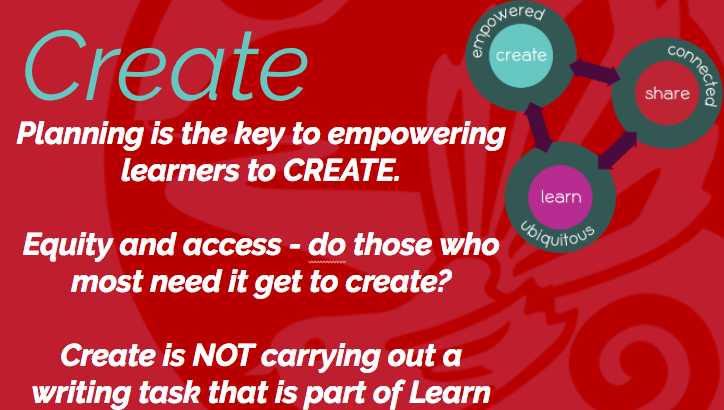
On  a personal and professional note there are some basics that classroom teachers need to put in place.   Basic structures to maintain so students have equitable access to tools that enhance and support their creativity.
1. A roster that works in rotations within class hours that has every child have access to the devices where animation, paint programs and iMovie can be accessed
2. A clear task and rubric to guide the students creation
3. A checkpoint weekly to show progress, give praise and prompts
4. An absolute doing away with the 'Creative' devices - (Apple flatscreens in our place) being used as a reward.  They are NOT - they are part of the everyday learning activities.
5. SHARE:  a showcasing of creative work on media such as PENN (School TV news network), class and individual blog, team/class viewing.
6. Feedback: Give students the chance to give feedback and reflect

Part of my teaching practice finds me role playing, singing, moving and rhyming to help my learners. This has meant my students have had the chance to reflect this in movies we've made to share our learning.    It's in these creative moments that I have witnessed first hand the embedding of their learning.  Embedding that runs deeper and wider where creativity is encouraged and expected.   Engagement high.

Monday, 15 May 2017

Using assessment data for 'Staff' and 'Students'

Professional Development with Jo Knox is a great support to my teaching and students.  AND my COL inquiry even!   This particular workshop looked at using student data to empower the learner.  A good chunk of Jo's presentation broke down steps we go through with assessments such as the IKANS.

You may recall that I have been using the IKANS as a starting point for my data sharing with students.

 I carried my action plan to highlight the strongest and weakest strand from the IKANS with my target students.   A common complaint from us all was 'too fast!'.   Jo shed light on an extended approach to using the IKANS - some of which I'm happy to say I've tried too!

In the above image you will note that FIRST you mark the IKAN, SECOND you show the students the answers.   Allowing them to identify what they think were 'silly mistakes' for themselves.   Students are then allowed to complete these questions and have them marked as correct.

This SECOND part I only carried out partially in showing the students the 'knowledge' they needed to be correct rather than letting them first scan to see what they could get right.    Also note here - we are actually extending the test time - further than the fast screen flashes they experience in test time.

Formative assessment: PAT, IKANS and GLOSS.   How do our students see these results?  Often one piece at a time.  A time I bring them together to date is when I am trying to make an OTJ for upcoming reporting season - mid year summary to prompt my next steps.   Jo suggests to use a 'Spidergraph' (slide 14 in presentation below) to show both GloSS and IKAN.   This in itself will be informative for students and surely motivate them to keep on with their learning sessions.  Empowering students by using their own data.


Next steps for my inquiry: CREATE rubric and templates that support the following:
1. Carry out the 'SECOND' step as outlined in Jo's presentation
2. Plot results out of Spidergraph
3. Implement activities that prompt reflection on data
4. Decide WITH student what our next steps are in learning in the number strand
5. Implement support this choice in follow up activities and home learning

Monday, 10 April 2017

Te Taiao O Tamaki - learning that is ubiquitous and rewindable!


 Te Taiao o Tamaki quad blogging this term has been a highlight for students across our cluster. We are delighted to see names from our school listed in those who were very active in the Te Taiao o Tamaki quadblogging go kids!  In the lead up to this event Dorothy Burt led our staff meeting - focus was 'Ubiquitous Learning is Rewindable'. A good part of this had us focusing on the role our blogs have. It is here that students post about their learning which include artefacts of their collaboration with others and often their very own learning and creating processes. It is here that ubiquitous learning can be rewindable.

 In the presentation embedded above by Dorothy Burt you will find from slides 14 onwards, examples of blog posts where students have not only explained their learning in text but have captured video and voice recordings as evidence of their learning.

 I reflected on this as a teacher of year 7 and 8 students. My students are now in their 4th and 5th year of having their own blogs.   These are some questions we need to keep checking in on as educators of Manaiakalani Tamariki.

  • How do we as a team of teachers keep the students enthused and understanding their success when posting such artefacts of learning? 
  • What am I providing as a teacher to ensure this ubiquitous learning continues? 
  •  Does my planning through to delivery provide opportunities for learning to be captured and rewindable? 
  •  What feedback am I giving once this rewindable learning is posted by the students?
  • Opportunities to go back and 'rewind' their learning - is this time of reflection included enough times to enhance and support the learning journey?
Where to next:
As the team of teachers for year 7 and 8 students we often reflect on the above points.   In our collaboration when planning and delivering it is important to continually check over the components of learn, create and share.  At the end of term 1 we can see clearly that learning that goes through all three - provide experiences and learning opportunities that are rewindable.   The learning is embedded more effectively.

Our specific goal as a team is to continue building the create component of our learning along with ways to give timely feedback to our students further than the dialogue that happens in small group.    Feedback is crucial in motivating our learners, the power of an active audience has been and still is valuable to our tamariki.

We've discussed that in the less public domain of google drive we can give critical feedback.   On our blogs which are public we can give feedback with greater depth about understanding and messages projected through the posts.  This will prompt a more evaluative response from both students and teachers.

Looking forward to our celebration at Te Oro where our tamariki will get to capture and blog about this experience that will be rewindable and reflected upon.

Saturday, 31 December 2016

2016 the year of 'So'o Tau'au' - To join shoulders

So'o Tau'au, 2016 sign off from SchoolTV on Vimeo.


2016 has been everything BUT normal!   We had changes to the timetable weekly, family, new baby :) teacher's on leave and leaving, Papa's and a Mama passing -  and in all this our kids stayed amazing!  Stayed normal!  Why??
We knew how and why - to 'So'o Tau'au'.

So'o tau'au is a Samoan saying that you typically hear in times of challenge.  Families and elders will visit those in a time of trial to offer support, this statement will be made.    Typically in our team we have sayings that help to embed our school wide korero.   Rather than a growling - it's a prompt to re-focus using our korero - saying.   This we carried through our learning spaces, in and out of the classroom - Te Reo, camps/field trips, tech@Tamaki College, testing, tuakana teina, visiting speakers, fundraisers, health talks and more!

Early in term 2 I shared this Samoan saying with our team during one of our morning karakia times.   It became something we used year long along with all other korero.   With all the changes that were expected and especially those that were not - this saying was one we held fast to.

Signing off for 2016 - I would like to wish all the students and teaching staff of Team 5 a fantastic festive season!    Well done on another amazing year, you've all contributed to making this year one of positive difference.

Looking forward to what 2017 will bring - opportunity to again 'So'o Tau'au'.

Ia manuia lava le tausaga fou, faamanuia atu le Atua ia te outou uma.

Mrs Andrea Bakulich Tele'a

Simon says this about 'So'o Tau'au' 

Monday, 14 September 2015

IEP - yeah you know me!


IEP - Individual Education Plan = Yeah you know me??

Individual Education Plans
IEPOnline is for anyone involved in developing or implementing individual education plans (IEPs) to support students with special education needs. Central to the website is the Ministry of Education publication Collaboration for Success: Individual Education Plans (September 2011) which replaces the 1998 ‘Individual Education Programme (IEP) Guidelines’.
Connecting to my previous presentation 'To obey like a canoe before the wind' I have arrived at this point in my inquiry.   There are students in my classroom and across my team where school is a serious challenge to be a functional part of.  These students have - special needs in the classroom daily.  You plan for groups at a time, however the plans must then be tailored again to support these particular individuals as their ability to work in a small group is challenging for themselves, their peers and teachers.
It has been aptly put on the TKI site, under the title 'How to succeed at IEPS': 
The IEP process is about writing students INTO the New Zealand Curriculum rather than writing students out.   
This has a teacher thinking, dreaming and looking ahead to the new term of what can be done for the INCLUSION of these students in the day to day, week to week running of the learning environments we strive to create, maintain and sustain??  What do I write into my plans to ensure these students are not just here in body but seriously engaging with the curriculum? 
My vision is to have blocks of learning change during the week for these particular individuals.   Relate to the time of day/week where the student tends to become disengaged or may need a 'second wind'.    Recent talks also with GATE in our staff meetings have supported this view.
For example:
Sporting student: weekly learning sessions with our Sports Teacher and Coordinator, linking to learning in classroom. Planning how to tackle the tasks set and further.  Linking to community and region sporting events and goals.  Mentoring with people in community outside PES?
Naturalistic student: weekly sessions to work on garden boxes in block and further.  Support from our school caretakers etc.  Linking this to the wider community and it's benefits.  
All this would need to be consistent and regular to ensure engagement and shifts of positive change for the students.
Barriers: 
  • the teachers/adults/mentors need to be available consistently.  
  • feedback and feedforward to be regular from student/mentor and teacher to ensure progress is monitored and recorded
  • resourcing of people to work one on one and to fund the projects for these programmes

Solution
  • look at timetable of team teachers, locate time specifically for the set up 
  • research funding/resources available for this type of IEP - more individuals to make up the different focus groups?
  • regular updates on the progress of these programmes, record and share with SMT for future

In striving to achieve this we will be looking closely at what these particular learners have in their winds and hopefully provide the 'second wind' .   It will certainly differ from the majority.   

Imagine if we get this right the IEP will have these students saying - 'Yep, teachers knows me!!